
Main Article Headline |
Near Whittlesey, people built wooden roundhouses above a river. Then fire sent the whole settlement into the mud preserving an extraordinary snapshot of life around 3,000 years ago. |
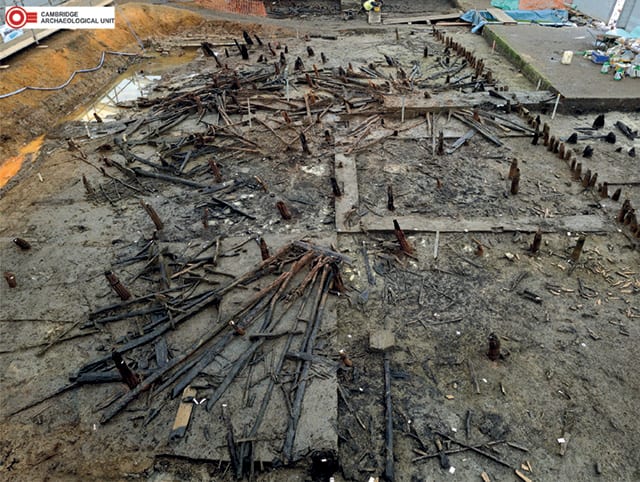
Somewhere near Whittlesey, around 3,000 years ago, people were getting on with ordinary life in wooden roundhouses built above a river.
They cooked. They stored food. They made things. They probably had the Bronze Age equivalent of a drawer full of bits nobody knew what to do with.
Then their settlement caught fire.
The houses collapsed into the water and wet silt below, taking many of the inhabitants' possessions with them.
Normally, that would have been the end of the story.
Instead, the mud did something remarkable.
It preserved them.
And that's why, thousands of years later, archaeologists near Peterborough were able to uncover Must Farm one of Britain's most extraordinary Bronze Age sites.
It sounds suspiciously like something from a historical drama. It isn't.
First things first: what was the Bronze Age?
When we say Must Farm was a Bronze Age settlement, we're talking about a period when people in Britain were using bronze to make tools and other objects, long before the Romans arrived.
Historic England dates the Must Farm settlement to around 850 BC. Put another way, the people living here were going about their lives roughly eight centuries before the birth of Christ.
Peterborough United was still some way off.
They really did build their homes above the waterMust Farm stood in the Flag Fen basin, near Whittlesey.
And these weren't ordinary houses sitting beside a river. Archaeologists found circular wooden homes built above a river channel, supported by timber posts driven into the ground.
Essentially, they were homes on stilts.
It sounds like an unnecessarily complicated way to build a house until you remember that the surrounding landscape was wet and marshy.
Building above the water made sense.
Inside and around these homes, people were doing surprisingly familiar things.
They prepared food, stored possessions, made objects and organised their living spaces.
Obviously, there was no Wi-Fi password stuck to the fridge. But these were homes.
That's an important distinction, because it's easy to think of prehistoric people as somehow distant or mysterious people who mainly wandered around holding spears and occasionally constructed something archaeologists would spend the next 3,000 years arguing about.
Must Farm gives us something much more personal.
It shows us ordinary life.
Then everything went badly wrongAt some point, the settlement caught fire.
The wooden structures burned and collapsed into the river below. For the people living there, this would have been a disaster.
But something unusual happened afterwards.
The remains sank into wet silt.
Silt is the fine mud and sediment that settles at the bottom of rivers and other bodies of water.
Because the remains became waterlogged and were buried, much less oxygen could reach them.
Why does that matter?
Because oxygen helps the bacteria and other organisms responsible for decay.
With less oxygen available, materials that would normally rot away particularly wood and other organic materials - had a much better chance of surviving.
So, rather strangely, the combination of fire, water and mud helped preserve the settlement.
Not exactly a conservation technique we'd recommend trying at home.
But remarkably effective.
So why is Must Farm called ‘Britain's Pompeii’?
You may have heard Must Farm described as “Britain's Pompeii” or a “Bronze Age Pompeii”.
At first glance, that sounds like somebody in marketing got a little excited.
But there's a good reason for the comparison.
Pompeii, in Italy, was famously buried following the eruption of Mount Vesuvius in AD 79. The catastrophe preserved an extraordinary snapshot of Roman life.
Must Farm is obviously very different.
There was no volcano near Whittlesey, which presumably comes as a relief to everyone currently living there.
The similarity is in what happened after the disaster.
A sudden destructive event preserved a moment of everyday life that archaeologists could study centuries or, in Must Farm's case, millennia later.
The University of Cambridge has described the Must Farm houses as among the best-preserved Bronze Age dwellings ever discovered in Britain.
And this is where the site becomes genuinely extraordinary.
Archaeologists didn't just find marks where houses used to beAt many ancient sites, archaeologists find clues.
A line of postholes might show where a wooden building once stood.
A posthole, incidentally, is pretty much what it sounds like: the hole or mark left in the ground where a wooden post once stood.
From those clues, archaeologists can work out the likely size and shape of a building.
Must Farm gave them much more.
The waterlogged conditions preserved substantial pieces of the wooden structures themselves, along with household objects and other materials.
That's incredibly unusual.
Wood doesn't generally have a habit of waiting patiently for archaeologists for 3,000 years.
Usually it rots.
At Must Farm, researchers were able to get unusually close to the physical homes in which Bronze Age families actually lived.
It's the ordinary stuff that makes Must Farm extraordinaryThis might be the most interesting part of the whole story.
Must Farm isn't important simply because archaeologists proved that Bronze Age people lived near Peterborough.
We already knew prehistoric communities lived across Britain. What makes the site special is the detail.
It gives us a glimpse of people living their lives rather than simply leaving behind monuments and graves.
They built houses. They prepared food. They made and used containers. They produced textiles. They kept possessions around them. They had routines.
And then, suddenly, something happened that disrupted all of it. Imagine having to leave your home unexpectedly today.
What would still be sitting on the kitchen worktop?
What would be beside the sofa?
What would you grab?
What would you leave behind?
Those ordinary objects would tell somebody quite a lot about your life.
That's essentially why Must Farm is so fascinating.
Archaeologists weren't simply looking at “the Bronze Age”.
They were looking at the remains of a particular community, caught at a particular moment.
That makes 3,000 years feel surprisingly close.
And all this was sitting near WhittleseyPerhaps that's the best part of the story.
You don't need a lost city, an Egyptian pyramid or an Indiana Jones hat for archaeology to be extraordinary.
Sometimes it's hiding beneath the landscape you've driven past hundreds of times.
Near Whittlesey, people built an ingenious settlement above a river. Around 850 BC, it burned.
The houses fell.
The mud swallowed them.
And, completely unintentionally, the conditions helped preserve a remarkable snapshot of people's lives for thousands of years.
No dragons. No lost kingdom. No ancient curse.
Just clever construction, one terrible fire and some extremely helpful mud.
So the next time somebody claims Peterborough's history begins and ends with the cathedral, you can politely point them towards the Flag Fen basin.
People were building remarkable homes around here long before anyone had heard of Peterborough Cathedral.
Or Peterborough, for that matter.
What's the strangest Peterborough fact you know?
There must be more local stories that sound completely made up but turn out to be true.
What's the strangest fact you've heard about Peterborough, Whittlesey or the surrounding area?
Leave it in the comments particularly if you know where the story comes from.
We'll check the best ones against museum, archaeological and historical sources, and your suggestion could become the next local-history story we investigate. |
0 Comments
Join the conversation
Be the first to comment
Share your thoughts above.